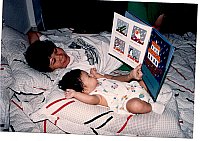
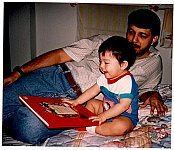
Well, my son began reading short phrases at 2 1/2. He was a normal baby just like any other. We started reading to him as soon as he was born. We also used a comprehensive reading program for babies. In retrospect, it was then my best "captive" times before he could crawl away to explore the "world"- though exploration is part of a child's growth as well.
Yes, a toddler can have a headstart in preschool literacy, and in fact, it is a wise move to give him such a great foundation that provides stability and confidence. It is not a new concept anymore as literacy advances. It is not just educators, but parents who affirm pre kindergarten reading.
There are many little toddlers who can recognise words and apply them accurately. Today, many parents are learning to engage their babies to use their God-given senses My son started matching words without the help of pictures..(words like: eyes, ears, nose, mouth). How do I know ?
I would prop him up on a bed/ chair and show him word charts without pictures - one word at a time - without reading aloud. When he sees a word like "nose", he would point to his nose ....etc. and then all the different parts of the body. This was when he was about 6 to 8 months.
Using a pre Kindergarten reading program can help kids to read early in life and moms have no worries about kindergarten readiness when kids reach the age for preschool.
What’s in a Kindergarten Reading Program? What distinctives should I look for in choosing a good Kindergarten Reading Program?
Here are some tips on how to choose a great Kindergarten Reading Program.
A good Kindergarten Reading Program MUST be:
A good kindergarten reading program MUST NOT:
Preschool reading skills can be mastered by way of phonics games, children poems, children’s stories, or kindergarten sight words. I have used various programs with my child, from sight words to stories, to visuals and charts to encyclodpedia …etc and I centered on phonics as he learned best with this educational system. I have also tutored other kids using the phonic reading system and found that learning to sound words may be a slow process but it helps the child read more words in the long run. I shall discuss briefly on some available kindergarten reading program and will discuss more in detail on what is phonics, how to use phonics charts and cards matching them with objects, …etc
HOW DO PARENTS OR TEACHERS HELP KIDS TO HAVE A LOVE FOR LITERATURE ?
Read, read, read, and read
Most people would think of a good well developed and tested Kindergarten reading program to introduce into the reading system for a preschool child. While this may be great, personally I feel the most well tested and priceless method is to encourage moms and dads to spend hours with their toddlers and preschool kids on their laps reading a variety of literature: from fantasies, to fiction to non-fictions. Personally, I would cut back on fantasies and read more life stories.
All preschool teachers and child psychologists will attest to the fact that kids who have been regularly read to early in their childhood, would naturally develop a love for literature. With the love and passion for books, these kids usually excel in their early childhood reading, language arts and expressions which in turn snowball into a greater confidence in life.
Therefore, it is a conscientious effort on the part of parents, caregivers and preschool teachers to intentionally set aside time to read with the children. Young children love to be read to and love the comfort of a caregiver’s lap and your voice as this provides him with confidence that he is getting your attention and feeding in to his innate cravings for knowledge. This itself is a motivation and a prelude to hours of self reading. And once motivated, who can stop a child from exploring the world of books. Won’t you like your kids to be hooked onto reading than be hooked onto the monitor or TV screens ?
Have books and literature available and easily assessible.
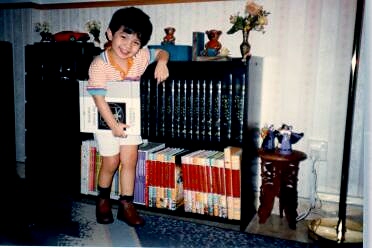
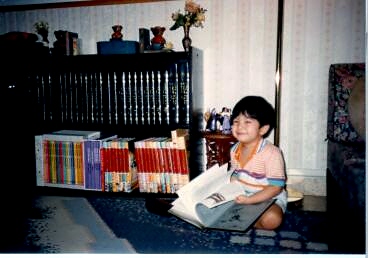
If a child adopts an intrinsic motivation to pick up any books to read, you’ve made it. What I did was to have a whole library available - from baby picture mini books (some comes in plastics and cloths) to toddler large prints to favorite preschool books to phonics practice readers. By 2 years old, my son had his first set of WorldBook encyclodpedia, which includes a set of Childcraft – a children encyclopedia set and a Young Scientist set. All these encompasses general information from preschool to adulthood, presented in a progressive and comprehensive way. At 2 yrs old, he had outgrown picture charts and books and was ready for real books with real picture illustrations.
It’s unbelievable but true. In fact the encyclodpedia was his favorite set of books above all other child centered colorful books. At 3 yrs old, he prides himself with the knowledge that a whale is not a fish but a mammal. He knew the parts of a car including the engines and shafts. He would tell my friends that a baby kangaroo, called a joey, lives in the mother’s pouch and that a Koala is not a bear. When he was 4 yrs old, and we were signing him up for kindergarten, the principal was surprised when he responded to her question that the little dinky car was not a car, but a Mobil truck.
OK OK enough of my bragging. What I’d like to get across to you is that young children can read, and that they are interested in real life stories. They need to be guided to do so. Without the interest and love for books imparted to them by parents, caregivers and teachers, kids will easily be drawn to the computer and to the TV screen. Today, my son, still in school, is drawn to the computer (this is the computer age, afterall), but he does not spend hours playing games; instead he would read Wikipedia (another form of encyclopedia) and search the web for news and current affairs.
Therefore a Kindergarten reading program – be it a commercial package or a homemade or school designed one – should be carefully considered because this is not only the initial step to childhood education, but it is the most important and crucial step to building the right and strong foundation for the child for years to come.
Read books with words and not limit your child to pictures
I used to think that babies only appreciates black and white pictures. Yes, this is true to newborn babies. However, babies do appreciate books with words. How often I’ve seen a very little child holding a book, pointing to the words and babbles away, pretending to read – even though they are holding the book upside down. Have you seen that ?
So I tried reading stories to my son when he was at crawling stage- about 8 mths old. When I read him stories of tigers and cheetahs, he would crawl to the wall where I had a wall chart of animals and touch the respective picture, as if to tell me that he knows what I was reading about, or he would crawl away to his toy box to pick up a toy related to the story.
I invested in Glenn Doman flashcard even before he began crawling. In fact, that was a good idea, so he would not crawl away and I had a captive audience. Truly, he was captivated by the word charts – just words with no pictures. Through that well attested program, my son was able to recognize significant number of words and was able to identify them by pointing to the respective objects. Read “How to teach your baby to read” by Glenn Domanhttp://www.amazon.com/How-Teach-your-Baby-Read/dp/0385111614
Increase your child’s vocabulary and listening skill
Before a child is motivated to read, there are many groundwork and foundations one needs to build before he can really appreciate any kindergarten reading program. The child must first be exposed to the beauty of language arts and appreciate the wealth of spoken words and vocabulary. Generally children love to learn new words and they learn it effortlessly and enjoy applying them as soon as they learnt it.
Haven’t you seen kids who delight in using big words – even in the wrong places ? Yes, they are in the process of learning and applying it. Somehow, they will right themselves by observing the responses of the adults. Unfortunately, some adults unconsciously teaches and reinforces new words incorrectly by using slangs and colloquialism.
Many parents and people casually “baby talk” to little children, especially the toddlers and babies. “Baby talk” refers to language without a proper form or grammatical structure, often includes slang and words not found in the dictionary. Eg. “Wanna pee / wee?” instead of “Do you want to go to the toilet / washroom?” Young children, including babies, need to hear you speak in a full sentence, clear and concise – short but complete.
Don’t underestimate a child’s intelligence and ability to absorb big words or structured sentences. To a child learning a language, “tweety bird” is just as difficult or easy as “sparrow”; or “Mummy loves you” & “I love You”.
New words around the environmentYou don't need to rely on a kindergarten reading program to teach words and sentences. There are so many new vocabulary a child can learn everyday around the house and learning centre. Be intentional about teaching some of the objects that the child associates with. Name them and use them in different ways. One of the best word games I like to play is “I spy” Do you know this game? No kids should be spared of this game. “I spy with my little eyes a fan…. Now where is the fan? Hmm…” When the child is older, you can add colors, shapes and numbers to your spying game.
The more vocabulary the child has in his brain store, the easier and more likely it is for him to read and appreciate books because you can go beyond just showing pictures and single words. A Kindergarten Reading Program will enhance the learning process when a child has already been saturated with tons of opportunities to be exposed to the love of books.